Imagine this for a moment.
A severe storm rolls through your area. Power is out. Cell service is spotty. One parent is at work, another family member is at school, and nobody is quite sure where everyone else is.
Would your family know what to do?
For many households, emergency preparedness starts with supplies – water, food, flashlights, and first aid kits. Those are important. But even the best emergency kit can't solve a communication problem if family members become separated during an emergency.
Think of a family communication plan as the thread that ties your preparedness efforts together. Without it, even simple situations can become stressful and confusing. With it, everyone knows how to reconnect, where to go, and what to do.
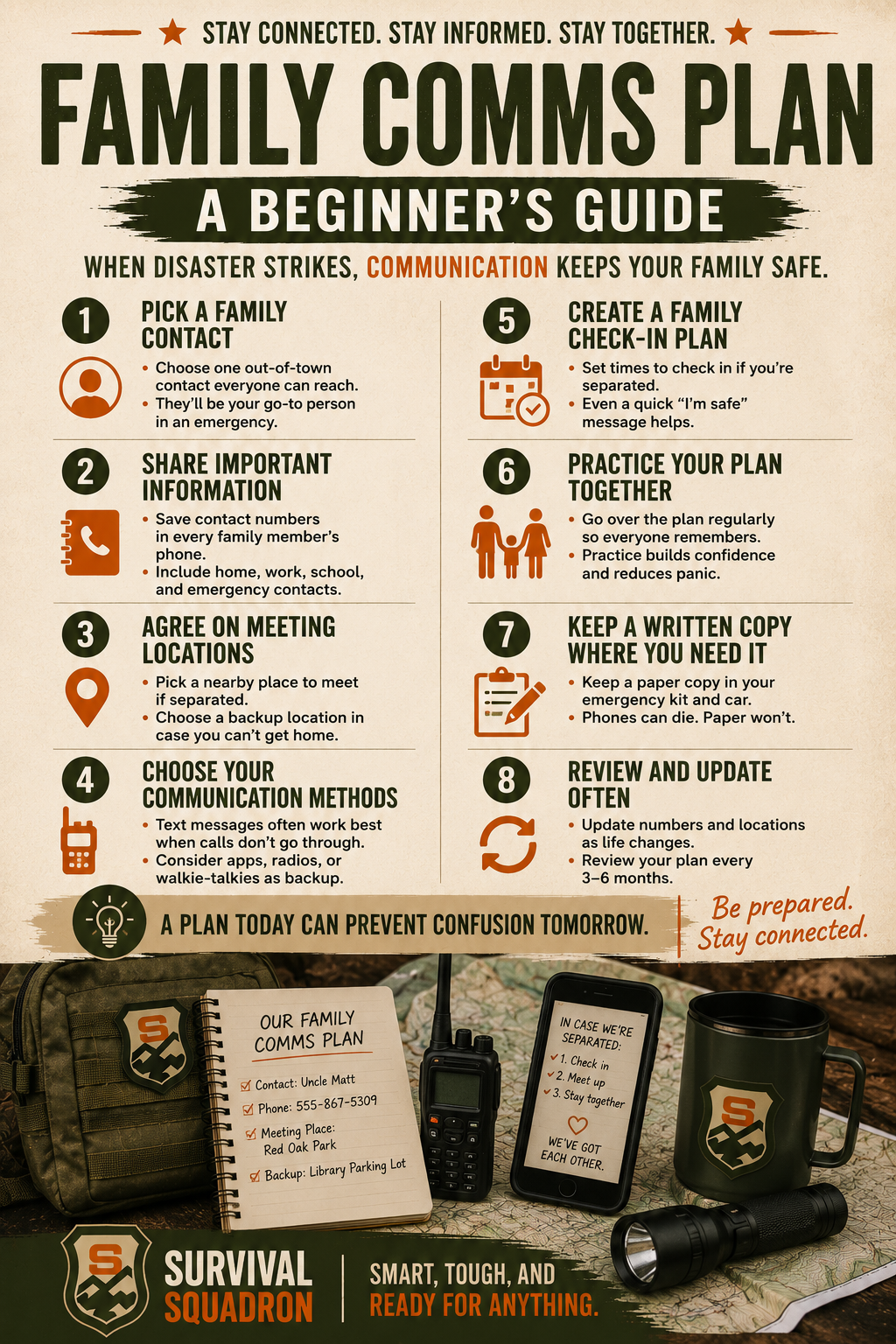
In this guide, you'll learn why family emergency communication plans matter, what to include in yours, and how to create one without making it complicated.
Why Communication Often Fails During Emergencies
Most families assume they'll simply call or text each other if something goes wrong.
The problem is that emergencies don't always cooperate.
Natural disasters, severe weather, power outages, and large-scale emergencies can overwhelm communication networks. During major disasters, cell towers may be damaged, overloaded, or temporarily unavailable.
Even if phones are working, family members may not be able to answer immediately.
When people don't know how to reach one another, uncertainty quickly becomes stress.
That's why preparedness experts consistently recommend creating a communication plan before an emergency occurs.
Practical Tip
Ask yourself one simple question: If everyone in your family lost access to their phones for 24 hours, how would you reconnect?
Every Family Needs an Out-of-Area Contact
Here's a preparedness strategy that many people overlook.
Choose one trusted friend or relative who lives outside your local area to serve as your family's emergency contact.
In some emergencies, local communication systems may be disrupted while long-distance calls still go through. Family members can contact the designated person and provide updates about their location and status.
Instead of everyone trying to contact everyone else, each person only needs to reach one individual.
This creates a central communication hub and reduces confusion.
According to FEMA preparedness recommendations, out-of-area contacts are one of the most effective components of a family communication plan.
Practical Tip
Choose someone reliable who understands their role and is willing to participate in your plan.
Decide Where You'll Meet Before You Need To
One of the most stressful parts of an emergency is not knowing where loved ones are.
That's why every family should establish meeting locations ahead of time.
Ideally, you should have:
A Nearby Meeting Place
This could be:
- A neighbor's home
- A mailbox at the end of the street
- A community park
- A local landmark
This location works for smaller emergencies such as house fires or sudden evacuations.
A Secondary Meeting Place
Choose a location outside your immediate neighborhood in case your area becomes inaccessible.
Examples include:
- A relative's home
- A church
- A community center
- A trusted friend's house
Having predetermined meeting locations eliminates guesswork when time matters most.
Practical Tip
Make sure every family member knows the address of both meeting locations, not just the name.
Create a Contact Card for Every Family Member
You might know important phone numbers by heart.
Your children probably don't.
A simple emergency contact card can make a significant difference if family members become separated.
Include:
- Family phone numbers
- Emergency contact information
- Home address
- Meeting locations
- Medical information, if needed
Children can carry laminated cards in backpacks, while adults can keep copies in wallets, vehicles, and emergency kits.
The American Academy of Pediatrics encourages families to maintain accessible emergency contact information for children during disasters and unexpected events.
Practical Tip
Take a photo of your contact card and save it on each family member's phone as a backup.
Don't Rely on Technology Alone
Technology is incredibly useful – until it isn't.
Prepared families build redundancy into their communication plans.
Consider including:
- Printed contact lists
- Paper maps
- Battery-powered radios
- Portable phone chargers
- Hand-crank emergency radios
When normal systems fail, simple backup tools become valuable.
Preparedness isn't about expecting technology to fail. It's about having alternatives if it does.
Practical Tip
Keep a printed copy of important contact information inside your emergency kit.
Practice Your Communication Plan
A plan that nobody remembers isn't much of a plan.
One of the biggest mistakes families make is creating a plan and never reviewing it again.
Children grow older.
Phone numbers change.
Meeting locations may become unavailable.
Regular practice helps ensure everyone knows what to do.
As football coach Vince Lombardi famously said:
"The will to win is not nearly so important as the will to prepare to win."
The same principle applies to preparedness.
You don't need elaborate drills. Even a short family discussion once or twice a year can improve readiness significantly.
Practical Tip
Review your communication plan every six months and update contact information as needed.
Communication Plans Help Children Feel More Secure
Some parents hesitate to discuss emergencies because they worry about frightening their children.
In reality, age-appropriate preparedness conversations often have the opposite effect.
Children feel more confident when they know:
- Who to contact
- Where to go
- How to reach family members
- What steps to follow
Preparedness replaces uncertainty with understanding.
The goal isn't to focus on worst-case scenarios. The goal is to help children understand that their family has a plan.
That reassurance can make stressful situations feel far less overwhelming.
Practical Tip
Use simple language and focus on solutions rather than potential dangers when discussing emergency plans with children.
Start Simple and Build From There
Like most preparedness efforts, a family communication plan doesn't need to be perfect on day one.
Start with:
- One emergency contact
- Two meeting locations
- A printed contact list
- A brief family discussion
That's enough to create a strong foundation.
Over time, you can add backup communication methods, evacuation plans, and additional preparedness measures.
Remember, a simple plan that everyone understands is far more effective than a complicated plan nobody remembers.
Final Thoughts
A family emergency communication plan is one of the most valuable preparedness tools you can create – and it costs almost nothing.
When emergencies happen, stress and uncertainty can make even simple decisions difficult. A communication plan removes much of that uncertainty by giving every family member clear instructions and a path forward.
You don't need specialized equipment or extensive training to get started.
Just a few conversations, a written plan, and a commitment to staying connected.
Because when something unexpected happens, knowing how to find each other may be just as important as any supply in your emergency kit.