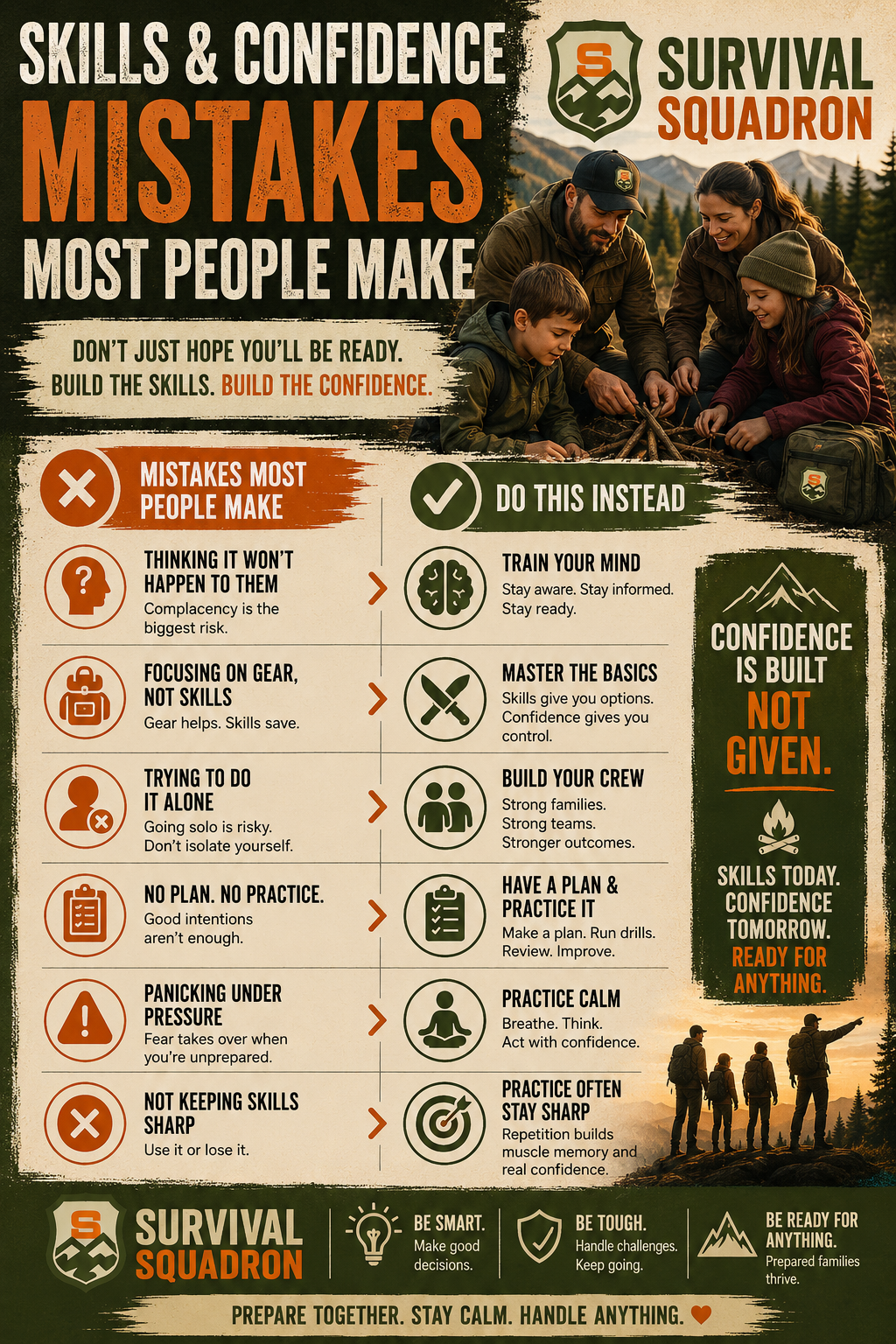
Most people assume they'll be ready when a challenge comes.
After all, they've watched videos, read articles, bought some gear, and maybe even put together an emergency kit.
But preparedness isn't something you suddenly discover in the middle of a crisis.
It's something you build beforehand.
Think of preparedness like learning to swim. You can read every book about swimming and buy the best equipment available, but if you've never practiced getting in the water, confidence disappears quickly when you're suddenly thrown into the deep end.
The same principle applies to emergency preparedness.
The good news is that most preparedness mistakes are easy to avoid once you recognize them. In this guide, we'll look at some of the most common mistakes people make and, more importantly, what to do instead.
Mistake #1: Thinking It Won't Happen to You
One of the biggest obstacles to preparedness is complacency.
Many people believe emergencies happen somewhere else, to someone else, at some other time.
Until they don't.
Power outages, severe weather, medical emergencies, vehicle breakdowns, and natural disasters affect ordinary families every year.
Preparedness isn't about expecting the worst. It's about acknowledging that unexpected events are a normal part of life.
The families who handle challenges most effectively aren't necessarily the strongest or the most experienced. They're often the ones who took a few simple steps before they needed them.
Do This Instead: Train Your Mind
Develop situational awareness.
Stay informed about potential risks in your area.
Pay attention to weather alerts, local emergency information, and changing conditions.
Preparedness begins with awareness.
Practical Tip
Spend 15 minutes researching the most likely emergencies that could affect your area and create a simple plan for each one.
Mistake #2: Focusing on Gear Instead of Skills
This is one of the most common preparedness traps.
People spend hundreds or even thousands of dollars on equipment while investing very little time learning how to use it.
There's nothing wrong with good gear.
Quality equipment can be incredibly valuable.
But gear is only a tool.
Skills are what make the tool useful.
A flashlight is helpful.
Knowing how to navigate in low-light conditions is even better.
A first aid kit is important.
Knowing how to use the supplies inside it is what truly matters.
Do This Instead: Master the Basics
Focus on developing practical skills such as:
First aid
Emergency communication
Fire safety
Navigation
Water storage and purification
Basic home emergency preparedness
Skills give you options. We talked about first aid a couple of weeks ago. We’ll cover the other practical skill here over the next few months.
Confidence comes from competence.
Practical Tip
For every piece of preparedness gear you purchase, commit to learning one skill related to its use.
Mistake #3: Trying to Do Everything Alone
Preparedness is often portrayed as a solo pursuit.
In reality, resilient people are usually connected people.
Strong families, supportive friends, helpful neighbors, and community networks all play important roles during emergencies.
No one possesses every skill or resource.
That's why teamwork matters.
During emergencies, people who have strong support systems often recover faster and adapt more effectively than those who try to handle everything alone.
Do This Instead: Build Your Crew
Focus on strengthening relationships with:
Family members
Friends
Neighbors
Local community groups
Preparedness becomes stronger when it's shared.
As author and leadership expert John C. Maxwell once said:
"Teamwork makes the dream work."
The same applies to preparedness.
Practical Tip
Get to know at least three neighbors and discuss how you could help one another during an emergency.
Mistake #4: Having No Plan and No Practice
Many people have good intentions.
Few have a written plan.
Even fewer practice it.
The problem is that stress changes how we think.
During an emergency, people tend to fall back on what they've practiced rather than what they've merely considered.
A plan doesn't need to be complicated.
It simply needs to exist.
Your family should know:
Emergency contact information
Meeting locations
Evacuation routes
Where emergency supplies are stored
Do This Instead: Have a Plan and Practice It
Create a simple family preparedness plan.
Then review it regularly.
Run occasional drills.
Discuss different scenarios.
Look for opportunities to improve.
Preparedness is a process, not a one-time project.
Practical Tip
Schedule a family preparedness review every six months to update plans and practice key procedures.
Mistake #5: Panicking Under Pressure
Fear is a natural human response.
The goal of preparedness isn't to eliminate fear.
The goal is to prevent fear from taking control.
When people lack knowledge, skills, and plans, uncertainty often creates panic.
Prepared individuals still experience stress, but they have a framework for responding.
They know what to do next.
And having a next step often makes all the difference.
Do This Instead: Practice Calm
Develop habits that support clear thinking under pressure.
These may include:
Controlled breathing
Mental rehearsal
Scenario planning
Stress management techniques
The more familiar a situation feels, the less overwhelming it becomes.
Practical Tip
When facing a stressful situation, focus on your next immediate action rather than the entire problem.
Mistake #6: Letting Skills Fade
Preparedness isn't a destination.
It's a practice.
Many people learn a skill once and assume they'll remember it forever.
Unfortunately, that's not how skill development works.
Whether it's first aid, navigation, emergency communication, or outdoor skills, abilities tend to fade without regular use.
Confidence fades along with them.
Do This Instead: Practice Often and Stay Sharp
Repetition builds muscle memory.
It strengthens decision-making.
It reinforces confidence.
Even brief practice sessions can make a significant difference over time.
The goal isn't perfection.
The goal is familiarity.
Practical Tip
Choose one preparedness skill each month and spend time reviewing or practicing it.
Confidence Isn't Given – It's Built
One of the most powerful lessons in preparedness is that confidence isn't something you buy.
It isn't something you're born with.
And it certainly doesn't appear magically during an emergency.
Confidence is built through:
Learning
Practice
Experience
Preparation
Every skill you develop adds another layer of capability.
Every plan you create reduces uncertainty.
Every practice session strengthens your ability to respond effectively.
Real confidence comes from knowing you've done the work.
Small Steps Lead to Big Results
One reason people avoid preparedness is that they think they need to do everything at once.
They don't.
Preparedness is built through small, consistent actions.
Learn one skill.
Build one habit.
Create one plan.
Practice one procedure.
Then repeat.
The families who become truly prepared are rarely the ones who make massive changes overnight.
They're the ones who keep showing up and making steady progress.
Final Thoughts
Preparedness isn't about having the most gear, the most supplies, or the most impressive setup.
It's about building the skills, habits, and confidence needed to handle challenges effectively.
Avoid complacency.
Focus on skills.
Build strong relationships.
Create and practice your plans.
Learn to stay calm.
Keep your skills sharp.
Because when challenges come, confidence won't come from what you own.
It will come from what you know, what you've practiced, and how well you've prepared.
Prepare together.
Stay calm.
Handle anything.