Preparedness isn't measured by how much gear you own.
It's measured by what you can do when life doesn't go according to plan.
A power outage lasts longer than expected. Your vehicle breaks down miles from home. Severe weather forces your family to change plans quickly. Someone gets hurt on a camping trip. None of these situations requires panic, and none requires you to become a hardcore survival expert.
What they require is preparation.
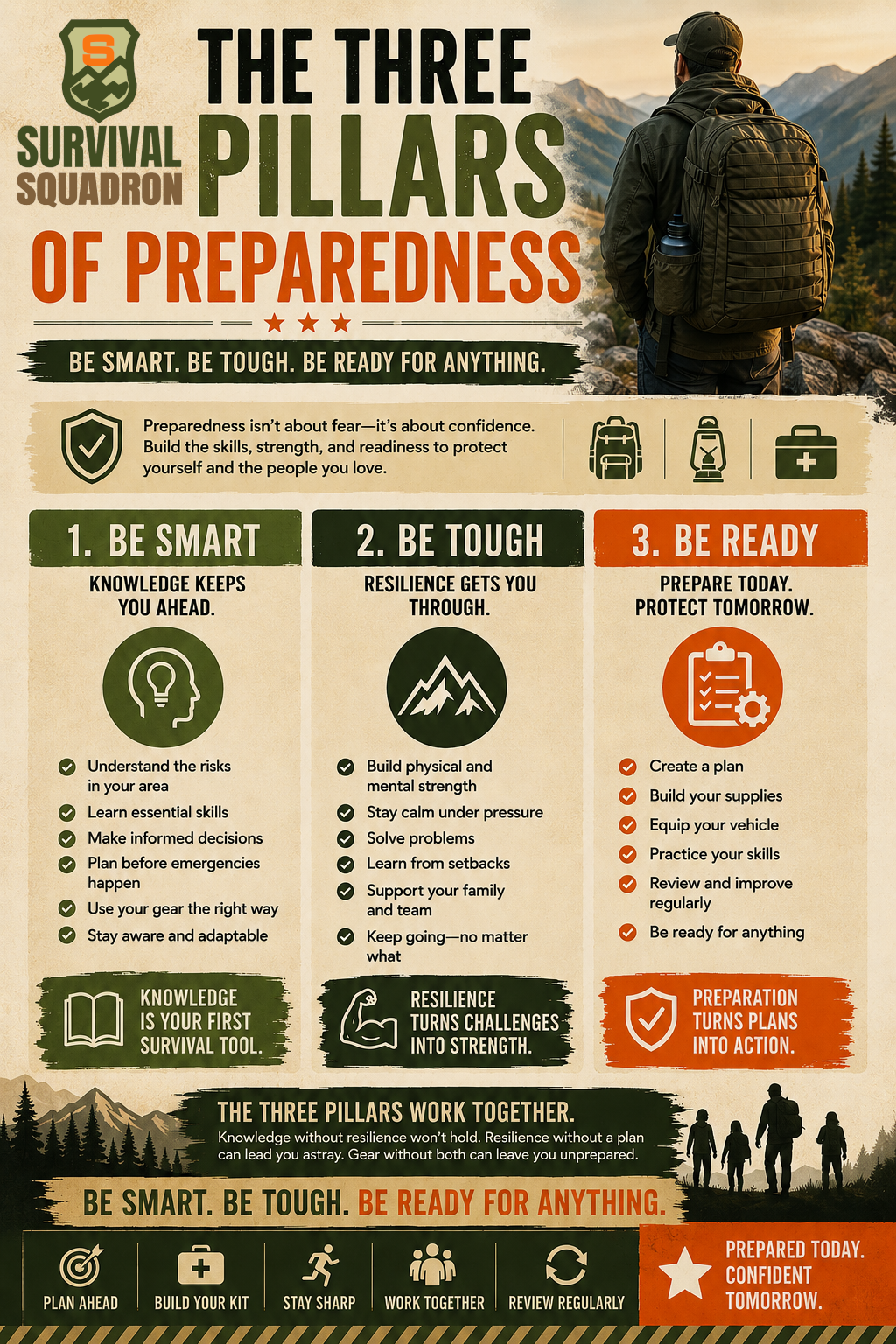
Think of preparedness like a three-legged stool. Remove one leg, and the whole thing becomes unstable. At Survival Squadron, those three pillars are simple:
Be Smart. Be Tough. Be Ready for Anything.
Being smart gives you the knowledge to make good decisions. Being tough gives you the resilience to keep moving when circumstances get difficult. Being ready for anything means developing the plans, supplies, and practical skills that turn preparation into action.
Let's look at what each pillar means and how you can strengthen all three in everyday life.
Pillar One: Be Smart – Knowledge Is Your First Survival Tool
Here's something that doesn't weigh an ounce but belongs in every emergency kit: good judgment.
Being smart about preparedness doesn't mean knowing everything. It means understanding risks, recognizing problems early, and making informed decisions before a manageable situation becomes a serious one.
Consider severe weather.
Someone who waits until a storm arrives before checking the forecast, looking for flashlights, and figuring out where to shelter is already playing catch-up.
A prepared person has thought about those questions beforehand.
Being smart means developing habits such as:
Knowing the emergencies most likely to affect your area
Monitoring weather and emergency alerts
Learning basic first aid
Understanding how your emergency equipment works
Knowing multiple evacuation routes
Keeping important contact information accessible
Recognizing when conditions are becoming unsafe
The Federal Emergency Management Agency encourages households to understand their local risks and make plans before disasters occur. That simple shift – from reacting to anticipating – is one of the foundations of practical preparedness.
Knowledge also prevents one of the biggest preparedness mistakes: relying entirely on equipment.
A compass doesn't help much if you don't understand navigation. A first aid kit has limited value if you don't know how to use what's inside. A generator can become dangerous when operated incorrectly.
Gear gives you tools. Knowledge tells you what to do with them.
Practical Tip
Choose one preparedness skill you don't currently know and spend 30 minutes learning about it this week. First aid, navigation, emergency communication, water storage, fire safety, and generator safety are all excellent places to start.
Pillar Two: Be Tough – Resilience Is Built Before You Need It
Being tough doesn't mean pretending nothing bothers you.
It doesn't mean ignoring fear, discomfort, or stress either.
Real toughness is resilience – the ability to adapt, think clearly, recover from setbacks, and continue moving forward.
That's especially important during emergencies because things rarely unfold exactly as planned.
Maybe your normal route home is blocked.
Maybe the power stays out another night.
Maybe the weather changes halfway through your hike.
Maybe Plan A simply doesn't work.
Resilience allows you to say, "Okay. What's the next best option?"
Research on psychological resilience consistently points to factors such as adaptive coping, supportive relationships, problem-solving, and a sense of personal capability as important parts of handling adversity.
And resilience can be strengthened.
You build it every time you:
Solve a problem instead of immediately giving up
Practice a difficult skill
Exercise and take care of your health
Learn from a mistake
Stay calm when plans change
Help someone else through a difficult situation
Work through discomfort safely
That's why preparedness extends beyond emergency supplies.
Physical health matters.
Mental health matters.
Family relationships matter.
Community matters.
Practical experience matters.
All of those things increase your ability to adapt when circumstances become difficult.
Practical Tip
Practice controlled problem-solving during everyday inconveniences. When something goes wrong, ask yourself three questions: What can I control? What matters most right now? What's my next useful action?
Pillar Three: Be Ready for Anything – Turn Knowledge Into Action
"Ready for anything" doesn't mean literally preparing for every imaginable disaster.
That's impossible.
It means developing a strong enough foundation that you can adapt to many different situations.
This is where preparation becomes practical.
Start with the situations most likely to affect your household and build outward from there.
That might include:
Creating a family emergency plan
Building a 72-hour emergency kit
Keeping emergency supplies in your vehicle
Establishing a family communication plan
Learning evacuation routes
Maintaining first aid supplies
Keeping backup lighting and power available
Storing emergency water and food
Notice that none of those requires building an underground bunker or spending thousands of dollars.
Preparedness can start with a flashlight and some water.
Then you add a first aid kit.
Then extra food.
Then a portable charger.
Then you learn CPR.
Then your family practices its emergency communication plan.
Little by little, your capability grows.
That's the real meaning of being ready for anything.
You're not trying to predict every problem.
You're becoming more capable of handling whatever problem shows up.
Practical Tip
Don't wait until you can afford your "perfect" emergency setup. Pick one missing essential this month and add it. Consistency beats a giant shopping spree every time.
The Three Pillars Work Together
Here's where preparedness really starts to click.
Imagine you're hiking with your family when the weather suddenly deteriorates.
Being smart means you checked the forecast, brought navigation tools, understand the route, and recognize that conditions are getting worse.
Being tough means you remain calm, manage discomfort, help your family stay focused, and accept that changing plans isn't failure.
Being ready for anything means you have rain gear, water, first aid supplies, a flashlight, communication equipment, and a plan for safely turning around.
Each pillar strengthens the others.
Knowledge without resilience can disappear under pressure.
Resilience without knowledge can lead to confident but poor decisions.
Gear without either one can provide a false sense of security.
Put all three together, and you become far more capable.
Preparedness Should Include Your Whole Family
Preparedness becomes even stronger when it isn't limited to one person.
Every capable member of your household should understand the basics.
Children can learn age-appropriate skills such as:
Their full name and address
A parent's phone number
How and when to call 911
Where the family meeting place is
Where emergency supplies are stored
How to follow instructions during an emergency
Adults can divide responsibilities based on skills and circumstances.
One person might handle first aid supplies while another manages emergency communications. Someone may be responsible for pets while another gathers important documents.
The objective isn't to assign everyone a complicated job.
It's to make sure the family's entire preparedness plan doesn't depend on one person being available.
A prepared family works as a team.
Practical Tip
Hold a short family preparedness meeting. Ask everyone one question: "If we couldn't stay in our house tonight, what would we do?" The answers will quickly reveal where your plan is strong and where it needs work.
Confidence Comes From Practice, Not Purchases
There's a tempting shortcut in preparedness.
Buying gear feels like progress.
Sometimes it is. But purchasing equipment is easier than developing capability.
You can buy a first aid kit in five minutes.
Learning first aid takes effort.
You can buy a compass instantly.
Learning navigation requires practice.
You can build a bug-out bag over a weekend.
Knowing when, why, and where you would evacuate requires planning.
That's why practice matters.
When you repeatedly perform a skill, the steps become more familiar. Familiarity reduces hesitation, and reduced hesitation helps build confidence.
This doesn't mean turning family life into constant emergency drills.
Keep it practical.
Take your emergency gear camping.
Practice shutting off utilities when appropriate and safe.
Let the kids use the flashlights.
Review your evacuation route.
Take a first aid course.
Try navigating with a paper map.
Preparedness should become part of ordinary life rather than something reserved for disasters.
Practical Tip
Once a month, choose one item from your emergency supplies and make sure everyone who might need it knows how to use it.
You Don't Need to Prepare for Everything
This point matters.
Trying to prepare for every possible emergency can quickly become overwhelming and expensive.
Don't do that.
Build capability instead.
Water helps during countless emergencies.
So does food.
Lighting.
First aid.
Communication.
Shelter.
Basic tools.
Physical fitness.
Problem-solving.
Strong relationships.
These are flexible resources and skills that remain useful across many different situations.
As philosopher George Santayana wrote:
“The family is one of nature’s masterpieces.”
And protecting that masterpiece is ultimately what family preparedness is about.
You aren't preparing because you expect everything to go wrong. You're developing the knowledge, resilience, and practical capabilities that help your family take care of one another when something does.
Research on family resilience supports that broader idea. Families can develop resilience collectively, with their ability to adapt depending on how effectively the family functions as a system rather than simply how tough individual members are.
Practical Tip
When considering a new preparedness purchase or skill, ask two questions: “How many different problems could this help us solve?” and “Will this make our family more capable?”
Prioritize the things that answer both questions well.
Final Thoughts: Smart. Tough. Ready for Anything.
Preparedness isn't about living in fear of what might happen tomorrow.
It's about becoming more capable today.
Be smart.
Learn your risks. Build useful skills. Pay attention. Think before you act.
Be tough.
Strengthen your mind and body. Learn from setbacks. Stay adaptable. Keep moving forward.
Be ready for anything.
Make plans. Build your supplies gradually. Practice your skills. Prepare your family. You don't have to become an expert overnight. You don't need every piece of gear. And you certainly don't need to prepare for every disaster imaginable.
Start small. Learn something useful, practice it, add another layer.
Then keep going.
Because real preparedness isn't something you buy. It's something you build.
Be smart. Be tough. Be ready for anything.